
When Natalia’s home in Dmytrivka fell under occupation, the hardest part was not the shock itself, but the collapse of any sense of a safe place.
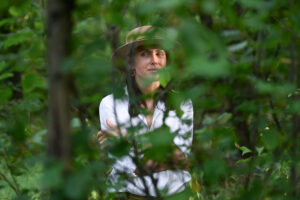
“NOT IN MY COUNTRY, NOT IN MY OWN HOME. I COULDN’T UNDERSTAND WHERE THAT SAFE PLACE WAS. IT WAS SO DIFFICULT TO FIND IT WITHIN MYSELF.”
This search for safety carries a longer memory. Her great-grandparents were part of the Ukrainian resistance and were sent to Siberian camps. What remained in the family was a simple inherited rule: don’t stand out — that’s when it becomes dangerous simply to exist.
Each morning, Natalia returns to the forest near her house. She walks different routes depending on the weather — and on whether there has been shelling. When the night has been difficult, she chooses the longest path.
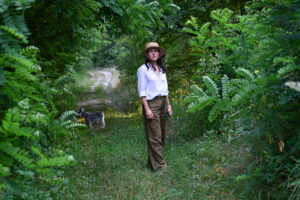
Her recovery is deeply sensory. She touches leaves, smells bark, notices how the forest changes after rain, and reads the direction of the wind before the curtains begin to move at home.
Recently, she discovered a practice that became central to her walks: instead of looking at the branches, she focuses on the space between them.
In that negative space, something in the body begins to widen again. The constriction of stress softens. Breathing returns.
What once felt like an intuitive bond with nature has become a precise daily ritual — one that restores rhythm, scale, and the possibility of safety from within, even while the war continues.

“You just need to try smelling. Touching. Looking at the space between the branches. These seem like simple things. But living in the city, we switch all of this off. Here, it all comes back.”
Project: Healing Land.Voices Voice: Natalia Location: Dmytrivka, Kyiv region, Ukraine